

Bisexuality

Bisexuality

Bisexuality is often misunderstood by the general population. A person who is bisexual is NOT necessarily equally attracted to men and women. People who identify s bisexual are comfortable having relationships with either gender.

Sexuality is not easily defined. A person’s sexuality can be more than how they identify. Alfred Kinsey, a famous sex researcher in the mid-twentieth century, proposed a sliding scale for understanding sexuality. Kinsey’s six-point scale ranged from 0 (exclusively heterosexual/straight) to 5 (exclusively homosexual/gay or lesbian).

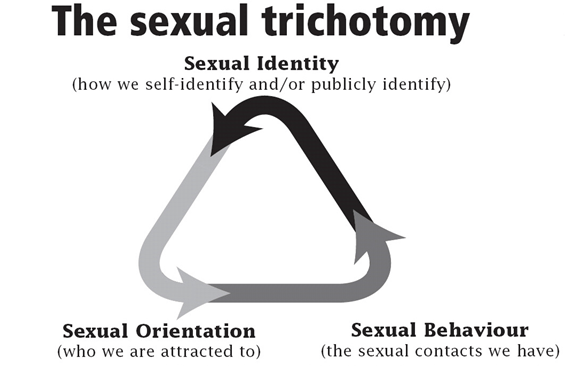
Another way one to understand sexuality is through the sexual trichotomy of identity, attraction and behaviour (See figure below). A person may identify as heterosexual (straight), be attracted to mainly women (attraction), and enjoy also enjoy sex with men and women (behaviour). So when we talk about bisexuality, we could be talking about many different formations.
COMMON MYTHS ABOUT BISEXUALITY

  • Bisexuals are sitting on the fence…….bisexuals cannot decide one way or another

For many people ideas about sexuality rely on opposites (man or woman, straight or gay), and bisexuality does not fit neatly into these opposite categories. It is not the responsibility of someone who identifies as bisexual to decide; it is our responsibility to understand.

  • Bisexuals like to look androgynous, neither male or female

The way a person looks, behaves and dresses are different things, and usually not related to sexual preference.

  • Bisexuals are promiscuous….Bisexuals have twice the chance at sex

Bisexuals, like straights, gays and lesbians will have different ideas about who they are attracted to. Because some identifies as bisexual does not mean they want to have sex with everyone or anyone.

The range of relationship styles varies as it does in straight and gay communities. Some bisexuals are in committed relationships; some are serial monogamists, in open relationships or in relationships with more than one partner, and some prefer casual relationships or celibacy, with every variation in between.

  • Bisexuals have raging libidos

It is sometimes assumed that a ravenous appetite for sex is what leads a person to bisexual behaviour. This is not true. The libido of bisexuals is the same as the libido of anyone else in the community, which ranges from not wanting sex at all to wanting it often, with every variation in between.

  • Bisexuals spread AIDS

The commonly cited scenarios include the married man who has gay affairs, and the woman who has affairs with men while in a lesbian relationship. It is unsafe sex, not bisexuality, which spreads AIDS and other sexually transmitted diseases.

THE BENEFITS AND/OR OUTCOMES OF COUNSELLING AND PSYCHOTHERAPY FOR BPD

Through therapy will may achieve some of the following benefits:

  • Exploe and udnertsand your idneitity;
  • Develop skills for dealing with the the bi-phobia present in society;
  • Develop Skills to manage associated symptoms of depression, anxiety and low self-esteem;
  • Develop skills in addressing unhelpful beliefs, thoughts, and behaviours;
  • Learn skills in forming and maintaining healthy relationship and friendships; and
  • Improve communication and interpersonal skills.

FURTHER INFORMATION ON BISEXUALITY

Bisexual Alliance Victoria

Gay and Married Mens Association (GAMMA)

RECEPTION HOURS

Mon - Thu: 10:00 AM - 5:00 PM

Fri: 10:00 AM - 2:00 PM

Sat - Sun: Unavailable

SYDNEY OFFICE LOCATION

FOR PROFESSIONALS

Dr Christopher Fox – Clinical Supervision Opportunities 2026

For Pricing See Bottom Of Page. 

Clinical supervision is an essential part of working therapeutically with clients. Clinical supervision is a professional requirement of all counselling, psychotherapy, psychology, social work and occupational therapy bodies. All people working in the helping professionals also benefit from clinical supervision (or practise mentoring).

All ethical and professional therapists have on-going formal clinical supervision to support their work in accordance with professional codes of practice requirements. Clinical supervisors are experienced therapists and maintain a responsibility for the good practice of supervisees and to protect clients from harm and unethical practice.  Clinical supervisors also have supervision.

Clinical supervision is a space for the supervisee to engage reflexively with the content and process of their client work. Through clinical supervision topics such as therapeutic techniques, therapeutic relationships, difficult problems, ethical dilemmas or issues which impact on the therapist personally as a result of the therapeutic process.

The focus in supervision is three-fold:

3 circles which read 1.	Therapy process – the development of clinical skills and awareness,<br />
2.	Self-in-therapy/therapy-in-self – recognise and manage personal responses, values and power,<br />
3.	Professional development – expand knowledge and skills.

Introducing your Supervisor – Dr Christopher Fox

headshot of Dr Christopher Fox

As a clinical supervisor I work from a collaborative and supportive framework to facilitate the growth of the therapist. I draw on critical reflexive practice where the supervisee moves beyond reflection to engagement in self-in-therapy/therapy-in-self/therapeutic self, self-care and development as a professional. A focus on the praxis issues of practice-to-theory/theory-to-practice encourages the therapist to maintain a best-practice model drawing on evidence-based and practice-based evidence informed approaches.

My professional focus is in the areas of psychosexual therapy, sexuality, and gender diversity, as well psychological wellbeing. My theoretical orientation draws on an integrative model of psychodynamic, Berne, Adler, humanism existentialism, Rogerian and solution-focussed approaches to therapy in the main.  My practice is also heavily influenced by systems (Satir, Bowen)/family and relationship therapy.  I also utilise creative therapeutic approaches including storytelling, therapeutic photography, and clay/play dough. As a public health specialist and experienced community practitioner I also supervise health promotion, welfare and community development workers.

I have worked with sexual and gender diversity, as well as sexual health and wellbeing for over thirty years. I am an European Certified Psycho-Sexologist with the European Federation of Sexology and European Society of Sexual Medicine.  I am Director of Sex Life Therapy – a specialist psychosexual and relationship therapy practice in Melbourne, and one of Australia’s oldest and largest psychosexual therapy services. 

I work as a Senior Lecturer in Sexual Health (Sexology) in the Faculty of Medicine and Health at the University of Sydney where I am the Co-Director of Sexual and Reproductive Health Programs and Pathway Coordinator for the Psychosexual Therapy Pathway in the Postgraduate Program in Sexual and Reproductive Health.   I hold an adjunct Research Professor in Sexual and Reproductive Health at the Fiji National University.  I am the President of the Asia-Oceania Federation of Sexology and have held executive positions on the governing councils of the World Association for Sexual Health, the Asia-Oceania Federation of Sexology and the Society of Australian Sexologists, including National Chairperson.

Indiviual and group sessions available 

Individual Clinical Supervision is bookable through Chris Fox and available to general counselling and psychotherapy (psychologists, social workers, OTs, counsellors, mental health practitioners) or psychosexual therapy (psychosexual/sex therapists, sexologists, sexual health counsellors) on a regular or ad-hoc basis.

Psychosexual Therapy Group Supervision held on 1st Tuesday of the Month 16.00-17.30.
This group supervision is open to existing psychosexual/sex therapists/sexologists. Groups are limited to six participants.

Emerging Therapist Group Supervision held on 3rd Tuesday of the Month 16.00-17.30.
This emerging group supervision is aimed at recently graduate therapists (psychologists, social workers, OTs, counsellors, mental health practitioners) and therapist with less than five years practise experience.  Groups are limited to six participants.

Cost 

Ad Hoc = $125
6-Pack = $635.00 ($105.83 per session).
12-Pack = $1,145.00 ($95.42 per sessions)

Outer Barcoo:  Rural and Remote Supervision held on 2nd Tuesday of the Month 15.30-17.30.

This is a general supervision group for practitioners in rural and remotes areas of Australia. The group will focus on practise issues and practice issues with a rural and remote lens.The two-hour groups will focus on traditional supervision and add a professional development aspect as well.  This is an online group. (3rd Wednesday of the month at 1430-1630). The group is limited to six participants.

My career started in rural practice and I have always maintained an interest and a connection with these areas.  Practising in rural and remote Australia has unique experiences which many urban-based therapists and supervisors do not grasp.

Cost

Ad Hoc = $170
6-Pack = $865.00 ($144.50 per session).
12-Pack = $1,470.00 ($122.50 per sessions)


If you are interested in individual or group supervision, please contact the office on (03) 9005 5213 or email [email protected]

Want to Make a Booking or Have a Question?

Call at (03) 9005 5213 or email us on [email protected]